
What if the world did not end with a bang, but with a rising tide that swallowed everything you once knew. All Will Fall is a high-stakes colony management sim that tasks players with leading a group of survivors across the rooftops of a flooded civilization.
In this article we’ll be giving a full review of the game and ranking it from decaf to fully caffeinated.
story:
For a genre that often prioritizes mechanics over narrative, All Will Fall delivers a surprisingly decent storyline. The narrative follows the desperate journey of a colony trying to survive after a global flood has turned once-sprawling cities into isolated island chains. This isn’t just background flavor for the building mechanics; the story is actually woven directly into the management process through society-based choices that mirror the moral tension found in games like Frostpunk. Every decision forces you to decide what kind of leader you want to be. You can choose to lead with integrity by doing what is best for your people, or you can lean into your inner tyrant to keep the city afloat at any cost.
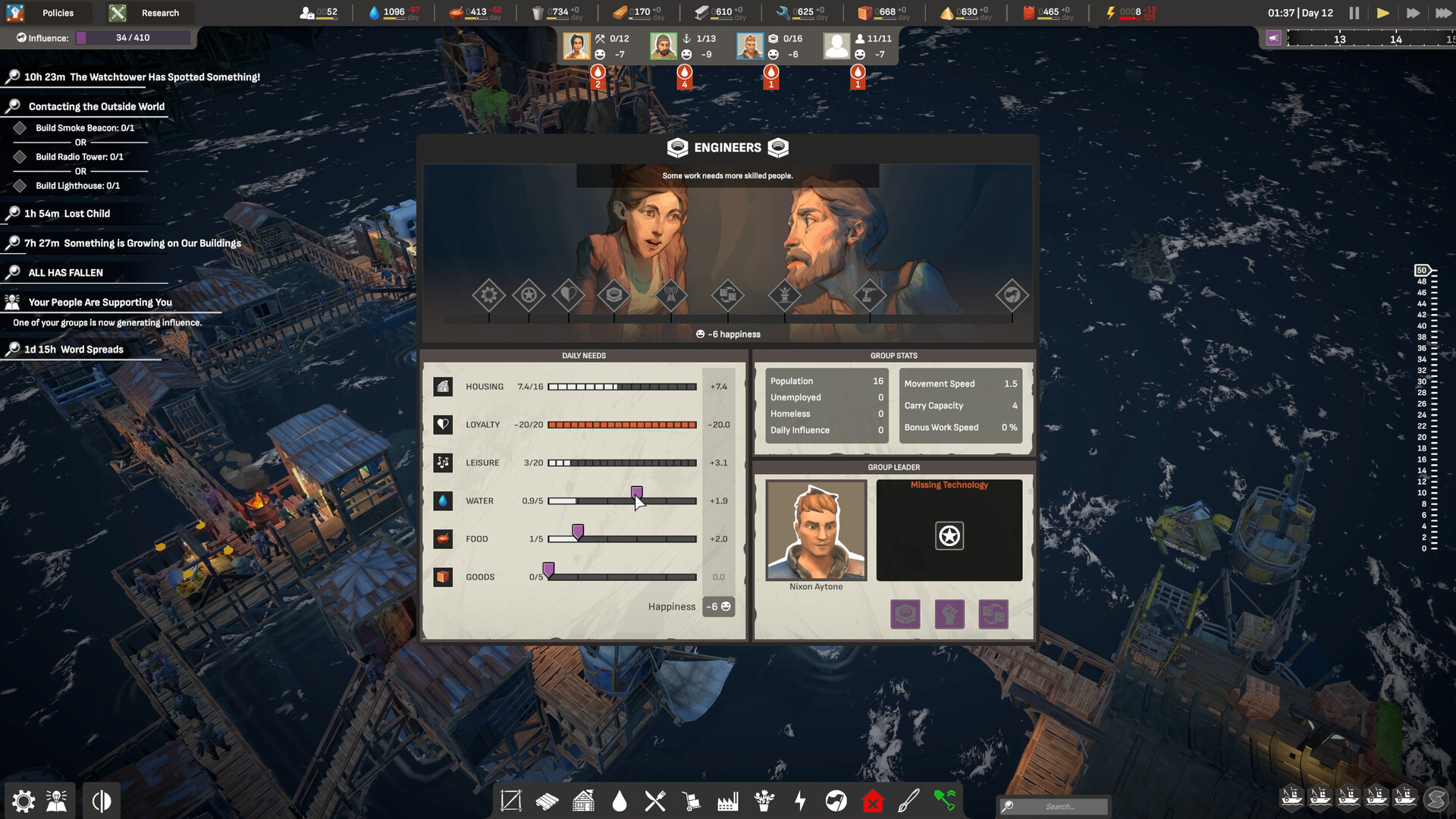
Regular story events will pop up to challenge your leadership at every turn. These events range from your people wanting higher rations, to missing children, to interactions with other survivors who come across your colony. Alongside this, you’ll be tasked with missions to explore the mysterious, waterlogged ruins left behind in the depths, which often requires some creative thinking. Each choice has clear and immediate consequences that can trigger recurring events, meaning a decision made on day five could come back to haunt the colony on day fifty. The narrative functions as a core part of your gameplay rather than a separate layer, which really brings the ruined world to life. While you might find the events get a little repetitive over long sessions and some choices are frustratingly locked behind strict requirements, it adds a layer of weight to every decision you make.
For bringing such narrative depth and consequence to the flooded ruins, I’m rating the story as Buzzed.
gameplay:
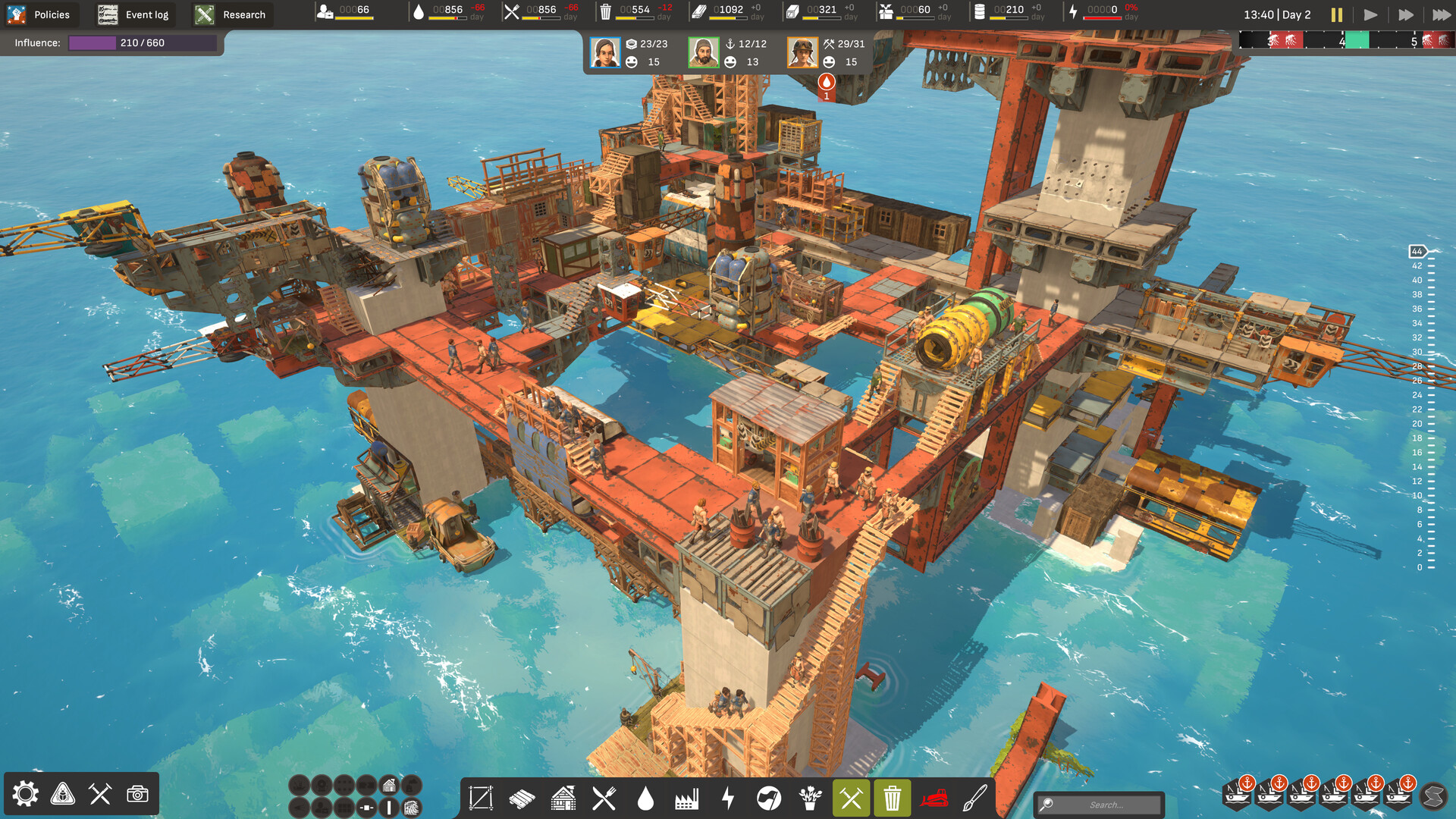
The gameplay is where things get truly complex. It’s a massive hybrid of city building, physics based construction, and colony survival. You have to manage your core resources like wood, scrap, food, and water to keep the lights on, but housing is just as vital. Citizens are split into three groups: Workers, Sailors, and Engineers. Each has their own needs and happiness scores, essentially acting as separate factions. You can even customize the treatment of these groups, potentially creating a class system where some get better resources while others suffer the consequences in the story choices.
Your resource collection is a constant balancing act between what you can produce and what you can scavenge. You will rely on specialized buildings like wood catchers to snag floating debris from the currents, water boilers to provide clean drinking supplies, and greenhouses to keep the colony fed. However, these self-sustaining production methods are rarely enough on their own. You are forced to venture out into the ruins to scavenge for scrap and rare materials hidden within the half-submerged skyscrapers. This creates a high-pressure dynamic where you have to decide whether to play it safe with your internal production or attempt to build walkways between each of the ruins to allow your citizens access. As your colony grows, the demand for these materials sky-rockets, making your resource management feel like a desperate race against the depletion of the surrounding ruins.
To keep up with these growing demands, you have a massive research tree to navigate. This is not just a linear progression; it is the backbone of your colony’s survival. You will start with the basics, but soon you will be unlocking advanced resource collection tools, complex food production buildings, and sophisticated ways to desalinate and collect water. As the environment becomes more hostile, your research shifts toward power production and more advanced structural supports, which can literally make or break your survival as a colony.
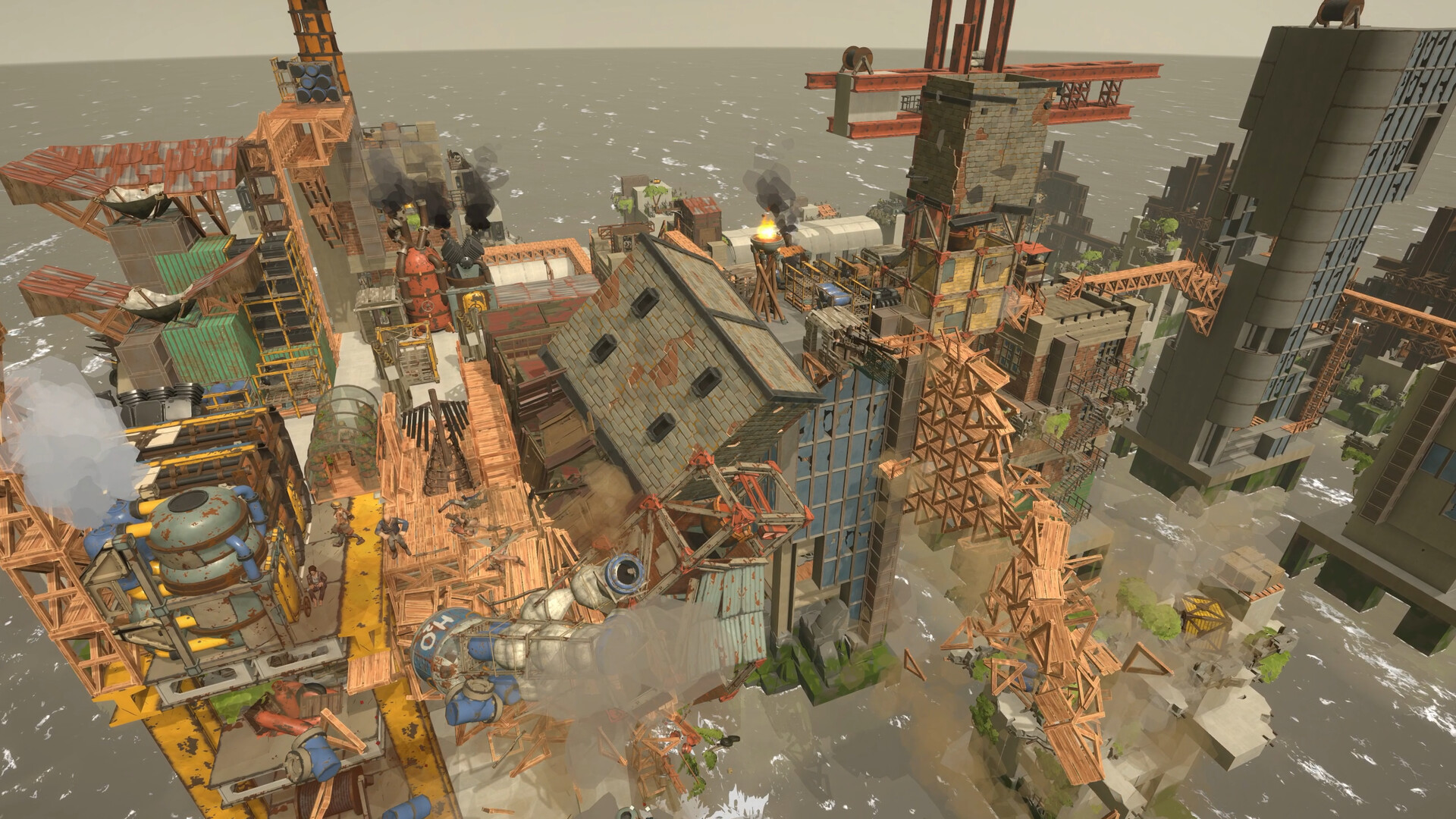
The physics side is what really separates this from a standard builder. Because the city is built on top of multi story ruins, you have to connect buildings with bridges that actually need structural support. If a bridge is not structurally sound, it will literally collapse and send your progress into the drink. There is a lot of trial and error involved in bridging even tiny gaps, but it adds a difficulty element to expansion that makes you really consider where you want to go. On top of that, you have to manage the tides. Low tide reveals new areas to scavenge, but high tide can flood your walkways and kill your citizens if they are caught out. Balancing the research for power production and food growth with the constant threat of rising water makes for an incredibly dense loop.
For its ambitious marriage of these elements, the gameplay is Fully Caffeinated.
design:
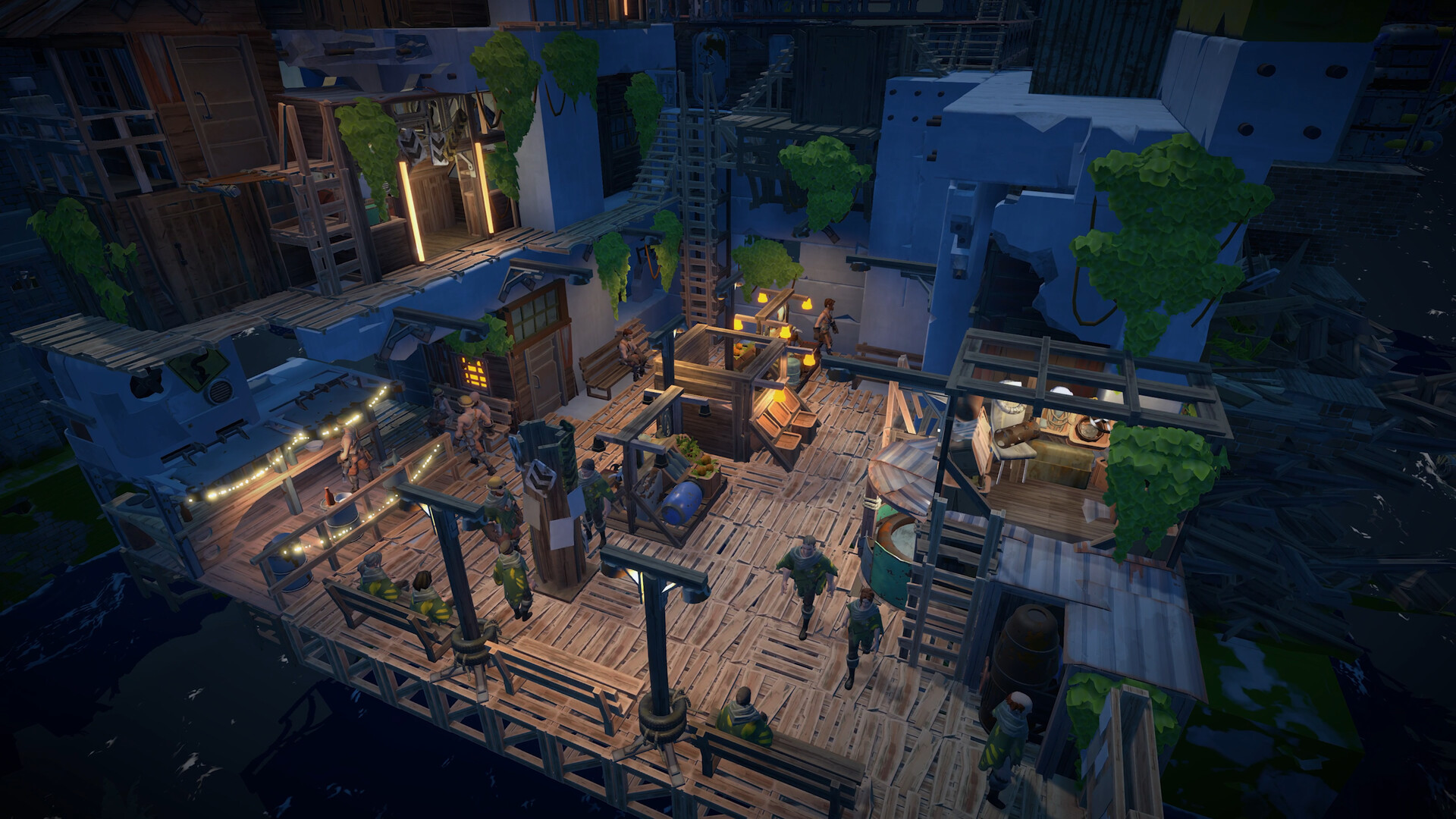
The design does a solid job of immersing you in a harsh and post-apocalyptic world. The ruins are intricate and the multi-story aspect is handled well, especially with visual cues like the moss growing on the submerged parts of buildings. It gives the world a gritty sense of realism that makes your survival feel more grounded. I really loved the realistic aesthetic of the buildings you place, which truly look like they were cobbled together from whatever scrap you could find.
The environment itself is a constant visual challenge because the game forces you to think vertically. You aren’t just building on a flat plane; you are navigating the skeletal remains of high-rise buildings. The way the game illustrates the different levels of the city is impressive, with a clear distinction between what is currently safe and what is being reclaimed by the ocean. You can see the rusted rebar and crumbling concrete that make up your foundations, giving you a constant visual reminder of how fragile your colony actually is. This verticality is not just for show, as it dictates how you plan your structural supports and where you place your most valuable buildings to keep them out of the splash zone.
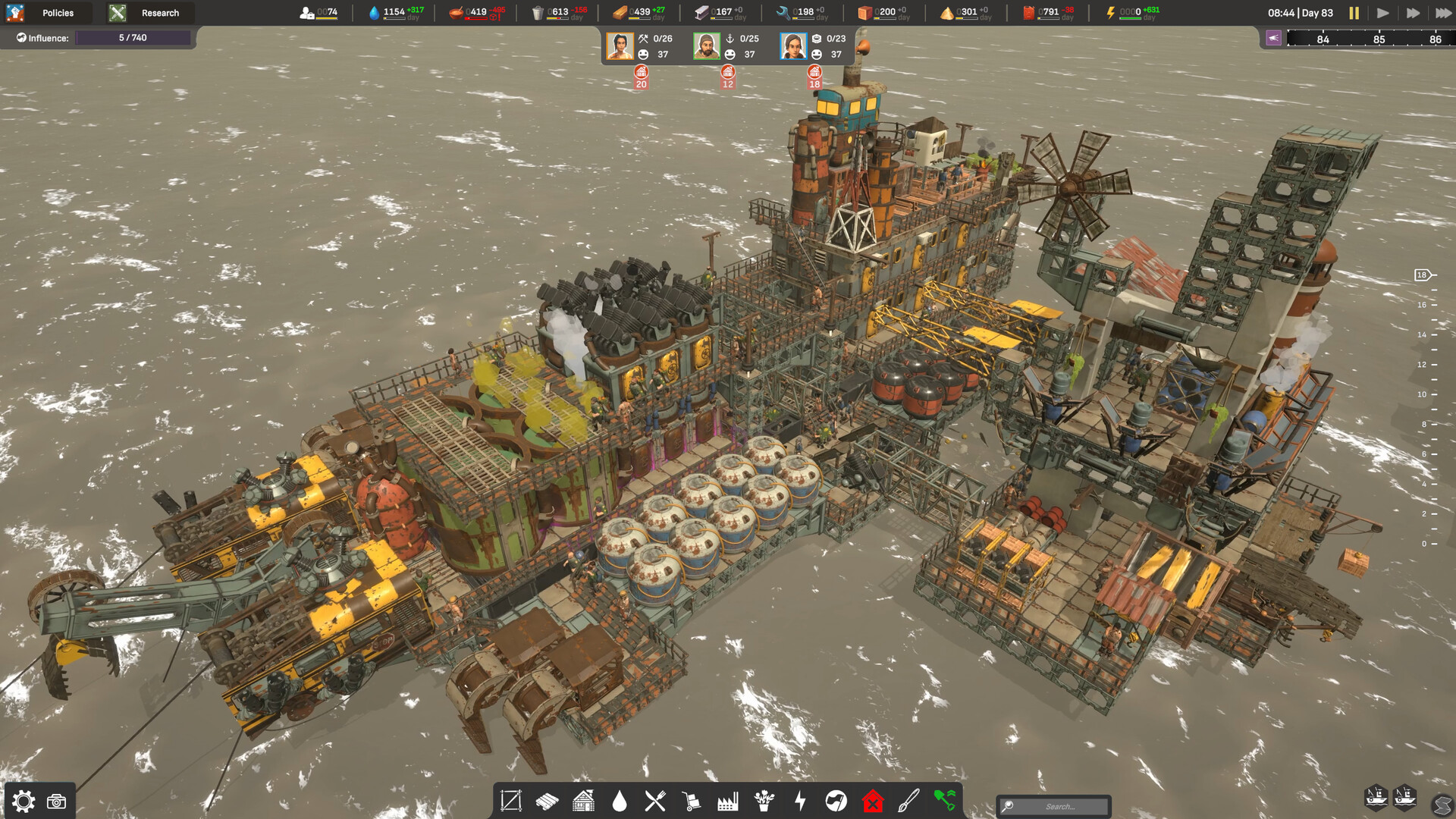
The weather elements are designed with high impact, throwing you into hectic storms or even a “junknado” that demands your immediate attention. These are not just visual distractions because they feel heavy and threatening as they tear through the settlement. The transition from a calm, low-tide morning to a violent, wind-swept high tide is visually striking and effectively communicates the danger your citizens are in. The animation of the rising water and the way it interacts with your structures further cements the immersion, making the environment feel like a character you have to constantly negotiate with.
The soundtrack is a reliable companion that stays in the background but provides you with crucial information through sound effects. Whether it is the sound of the wind or the creaking of your infrastructure, the audio design works hard to set the mood. While it is a grim world, it is one that feels beautifully realized in its decay.
For its atmospheric polish and detailed environmental storytelling, the design is Buzzed.
originality:
While All Will Fall might feel like a water-based version of Frostpunk at first glance, it carves out a distinct identity with a much more hands-on approach to management. It adopts familiar society management elements but pairs them with mechanics that feel entirely fresh. The inclusion of structural physics is the real game-changer. Most city builders allow buildings to be placed anywhere, but All Will Fall forces consideration of gravity and support in a way that feels unique. It moves beyond simple grid-based placement into something that feels more like an engineering puzzle.
By combining faction management with structural engineering and environmental hazards, the game delivers a specific type of tension that feels entirely original. It references the hardcore survival games of the past while introducing tactile and structural challenges that feel brand new. It isn’t just about managing people and food; it is about managing the laws of physics and the unpredictability of a rising ocean. The way progress is anchored to the skeletal remains of a dead world gives it a distinct identity in a crowded market.
For its innovative use of physics and the way it handles the flooded world, the originality is Fully Caffeinated.
The Final Brew:
If you love a good colony sim that mixes society management with resource gathering, All Will Fall is going to be right up your alley. The gameplay loop often manages to be frustrating and satisfying at the same time, which is exactly what a good survival game should do. It rewards patience and structural planning in a world that is constantly trying to drag the colony under the waves.
We’ve ground the beans, we’ve carefully weighed and pressed the grinds, and brewed this game down. Now it’s time for a taste test….
All Will Fall is Buzzed!
All Will Fall is available on PC via Steam. Check it out here!